|


|
/ faq /
faq.htm
Frequently Asked Questions
It is so hard to get information specific to Barbados Blackbellies to
help guide in their health, feeding, and lambing needs. The SHEEP-L listserv
is an excellent resource for all sheep breeders, but much of the information
that works well for wooly sheep is of little merit to the Barbados Blackbelly.
Below are some of the questions I've extracted from the phone calls I
receive each week and the questions posted to the Blackbelly
email group. More than anything else, I've learned that unlike the
wooly sheep that have been domesticated for thousands of years and have
come to depend on humans for every moment of their life, the Barbados
Blackbelly are still "very close to the earth" and don't need, or want,
much from us.
Disclaimer: This information pertains to Barbados Blackbelly
sheep living in Pueblo, Colorado, where it is excruciatingly hot in the
summer, pretty darned cold in the winter, and dry as a bone year-round.
I do not profess to be an expert on sheep, so don't yell at me if this
stuff doesn't work for you.
~~Identification~~
Q: What breed of sheep do I have?
A: We believe it is important that
you refer to your sheep by their correct breed. If you are interested
in learning more about blackbelly sheep, regardless of which breed your
raise, then there is a lot of information available for you on this site.
All we ask is that you take the time to learn which breed you raise and
disclose your sheep's breed and genetics when you sell breeding stock
or lambs.
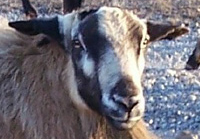
| A Barbados Blackbelly ram is polled—it
does not have horns. The ewes are also polled. There are fewer than
200 Barbados Blackbelly sheep in the U.S. If you have a polled ram,
please let us know. We
desperately need your help in preserving these rare genetics!

Photo by Glenn & Sheryl Hill, Oakland, AR
|
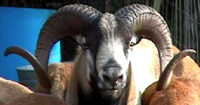
An American Blackbelly ram looks almost exactly
like a Barbados Blackbelly, but it has horns. The American Blackbelly
ewe may or may not have horns. Therefore, if you have only ewes
it is impossible to tell by looking at them which breed they are.

Photo by Chris Buchanan, Decatur, AL
|
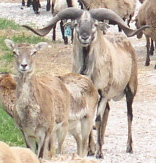
A barbado sheep isn't a breed of
sheep but rather a descriptive word that folks, primarily in Texas,
use to describe the cross-breeds that look similar to Barbados Blackbelly.
Barbado sheep may not necessarily have black bellies or facial barbs.

Photo by Nancy Richardson, Santa Fe, MO
|
Q: What is a hair sheep? What are these
sheep good for?
A: Hair sheep have hair, not wool. If they
live in a very cold winter climate, they will have varying degrees of
a woolie undercoat. This undercoat sheds out each spring, coming off in
clumps or long strands (like dreadlocks). To the best of my knowledge,
no one can use this hair for spinning/weaving, thus eliminating a fiber
market.
That leaves only two traditional markets available--meat and breeding.
I sell my sheep to both markets. The culls (my horned stock) I sell as
freezer lambs and my good polled stock I sell to other breeders.
There are additional markets being explored by very creative shepherds.
For instance, some folks are leasing out blackbelly sheep for weed control.
And as we continue to push for a hair sheep class in show competitions,
there will be new markets opening up from 4-H and other regional fair
competitions. In Texas, they sell well-horned rams to trophy ranches for
hunters to shoot. There also is an exotic pet market that many breeders
have tapped into.
A common question I receive from people meeting their first blackbelly
is “So if you don’t grow them for wool, what good are they?”
If we as breeders don’t have a quick and ready response to this
question, these people will go away convinced that our sheep really aren’t
good for much except spending money on. That will be a lost advertising
opportunity.
Q: My rams have horns but the ones
I see on your Web page do not. What is the difference?
A: Barbados Blackbelly breeders fall into
three groups, and many may belong to more than one group.
- Breeders of polled stock. The Barbados Blackbelly (both sexes)
are naturally polled. There are fewer than 200 Barbados Blackbelly
sheep in the U.S. If you have a polled ram, please contact me immediately.
- Breeders of horned stock. American Blackbelly rams have impressive,
curled horns. In 2004, the Barbados
Blackbelly Sheep Association International (BBSAI) designated
the American Blackbelly as a separate breed. The American Blackbelly
originated as a cross between Barbados Blackbelly, Mouflon, and Rambouillet
There is a thriving trophy market for horned rams in Texas and other
areas.
- Breeders of cross-bred stock. The University of Oklahoma
defines a separate breed, the Barbado,
to include horned sheep as well as sheep lacking the black belly.
These breeders intentionally cross-breed because they have located
a good meat market for sheep that are larger and mature more quickly
as woolies do but that maintain the ease of keeping and hardiness
found in the hair sheep. Some simply like to mix and match and see
what comes out in the genetic stirring.
I personally breed polled barbs because of the need to preserve the
breed's original genetic characteristics. I won't be making any money
at it for a long time. I believe that horned barbs are equally important
not only because there is a market for them but because by restricting
the growth of the breed to only polled sheep we actually diminish the
available gene pool by concentrating on too few breeding individuals.
This problem is already evidenced by the difficulty polled breeders
have in locating unrelated breeding stock.
It is important, however, than when selling stock (especially to polled
breeders) you be clear about the issue of horns and disclose any knowledge
of horns in your line's pedigree.
Q: Two of my ram lambs have developed
scurs even though their sire is a non-scurred ram. Is a ram with scurs
less valuable or desirable than a ram with no scurs?
A: (from Linda Sakiewicz) Scurs occur! Many
adult polled rams had scurs as lambs that were broken off during a fight
with other rams. Some people knock the scurs off so that they won't get
caught on fencing. These rams, then, appear to have been polled all along.
There is nothing wrong with scurs. Rams and ewes on the island of Barbados
are polled or have short scurs. Even though your ram and ewe do not have
scurs or horns they may still carry the trait for scurs or even for larger
horns. So if a ewe with the genes to produce scurs mates with a ram with
genes to produce scurs then they may produce offspring with scurs. About
1 in 10 of our purebred rams from polled parents will get horns large
enough that we will cull them rather than breed them.
Q: Will my sheep get as big as wooly
sheep?
A: Nope. A mature ewe will top out at around
70 lb as compared to the 100+ lb that a wooly gets to.
Q: These sheep sure seem wild. Do they
ever get tame?
A: Barbados Blackbellies are not kissy in-your-face
kind of sheep. At worst they are wilder than a wild deer and quite capable
of jumping 4-ft-high fences. However, over time they can learn to trust
you and will calm down considerably.
- Always move slowly around them and use no sudden turns or arm movements.
- Always talk gently while around them so that they become comfortable
with your voice.
- Try to use food as a reinforcement for trusting you. Some sheep
can be convinced to eat out of your hand. A couple of my sheep try
to jump up on me like a dog (a sharp hoof in the stomach is a rude
way to wake up in the morning!) Several of my sheep love dog biscuits
(those cheapie ones they sell at the grocery store for small dogs).
Yet in spite of the fine examples these sheep set, there are two ewes
I purchased from a very wild herd a year ago that still won't let
me close to them.
Q: Why do my sheep look like they have
leprosy in the spring?
A: These are hair sheep and every spring their
hair sheds just as it does on your cat or dog. Most of the time they will
scratch it off, but they can look shaggy for months. I usually get tired
of their looking like they belong in a rag bag and pluck the hair off
while the sheep eat. While I'm plucking, I remind myself how lucky I am
to not have to shear these lovely animals.
Q: I want to tag my sheep's ears, but
the ears are so small and even the small plastic tags for sheep are so
large that the ears just flop over. And that's a HUGH hole to put in a
little ear. What should I do?
A: I use two tags at different points in time in my
sheep's life. The day after birth, I tag my lambs with the small brass
tags that Premier (800-282-6631)sells. The tags (Item 615000) are $10.50
for a box of 100 (numbered consecutively) and the tag applicator (Item
615100) costs $10.00. The tags are easy to apply. (Place the tag so
that half of it hangs off the ear to allow for growth.)
The second tags is the plastic scrapie tag. I use Premier's 2X tag
because it rips out less frequently than any other tag I've tried. I
apply the tag either when the lamb leaves my property (which is federal
law) or reaches 1 year of age (the adult ear is big enough to handle
the plastic tag).
Q: How do I register my sheep? Is there
a breed registry?
A: The Barbados Blackbelly Sheep Assn Int'l
(BBSAI) (http://www.blackbellysheep.org)
is the registry for both Barbados Blackbelly and American Blackbelly sheep.
Only members
can register sheep and it costs $5 per sheep. The BBSAI also provides
a Book of Record where, also for $5, you can record cross-bred sheep that
do not meet the breed standards but are the product of registered sheep
or are used as a sire or dam to produce registered sheep.
Q: What kind of records do I need to
keep for my sheep?
A: You can download a good flock record form
at http://www.barbadosblackbelly.com/read_this/forms/flockrec.pdf
The USDA Scrapie Eradication Program requires you to keep records on participating
sheep for five years. Go to http://barbadosblackbelly.com/read_this/articles/comply_scrapie.htm
to learn more about this program.
~~Feeding and Pasture~~
Q: What should I feed my sheep? How
often? How much?
A: This is one of those "it depends"
questions. It depends on the nutritional content of the forage (hay, grass,
etc.) you have on hand; it depends on where you live; it depends on what
season it is. But here is some information to get you started: In the
winter when there is NO pasture, I feed about 1/2 lb of corn and a half-flake
of alfalfa hay per ewe per day. For my late-gestation and lactating ewes,
I double the grain ratio—1/2 lb corn and 1/2 lb sweet oats. Regardless
of what bagged grain you feed, make sure it doesn't contain copper because
copper is toxic to sheep.
Q: How many sheep can I put on my pasture?
A: Check with your local extension office to
learn how many pounds of animal you can grow on your pasture. Be careful
not to overstock because sheep will overgraze your pasture and kill it.
Here in eastern Colorado it is very arid. I rotate small paddocks of pasture
throughout the summer and am able to graze 16 to 20 sheep on 2 acres.
Q: Do my sheep need a mineral block?
A: It's a good idea to provide either a mineral
block or loose minerals. Make sure you purchase a mineral specifically
designed for sheep and goats; horse and cow mineral blocks contain copper,
which is toxic to sheep.
Q: What kind of pasture grass should
I plant for my sheep?
A: Check with your local extension office to
learn what grasses grow best in your area. Just about any high-protein
grass is fine. My sheep graze a 50/50 mix of alfalfa and perennial rye.
Blackbellies will do fine on poorer forage, but if you are planting new
pasture why not plant the grass that will grow best in your area.
~~Medical~~
Q: What kind of vaccination schedule
should I use for my Barbados Blackbellies?
A: Almost everyone does this differently, but
many Blackbelly breeders use NO vaccines on their sheep. No CD&T, no nothing.
These sheep are naturally resistant to disease and in some areas of the
country, such as North Carolina and Colorado, they seem to do well without
the help of vaccines.
Q: What kind of worming schedule should
I use for my Barbados Blackbellies?
A: You have to find where on the worm/don't
worm line you want to take your stand. Blackbelly sheep are naturally
tolerant of a worm load and to maintain that natural genetic resistance,
animals that are less resistant should be culled, whether naturally or
by selective breeding. If you routinely deworm your sheep just because
everyone tells you to, and if your sheep cannot thrive without being dewormed,
then you are contributing to the demise of this natural trait in the breed.
With proper pasture rotation and careful management, you should not
need to deworm your sheep. And if you must, then ask yourself why you
want to raise them in an area of the country that prevents you from
raising them naturally.
NOTE: Your geographic location, your pasture type and size,
and your flock size are only a few of the factors that affect your flock's
worm load. A very reputable breeder recently lost a lamb to worms as
a result of the hurricane storms in the East. In order to avoid the
weather, the flock hung around the barn area more and their worm count
increased to a fatal level.
If you choose not to worm your sheep, you must monitor their worm load
carefully!
Q: So, how do I monitor my flocks worm
count?
A: You can either take a sample to your vet
or you can learn to do it yourself. You will need a microscope, however.
- You can purchase a fecal kit from Farmstead
Health Supply for $28. The kit contains clear instructions and
a chart showing what the worms look like. All you need is the microscope.
The kit can do 8-12 tests.
- Alternatively, check out the links I provide on
my Links page to help you learn the method and see photos of various
parasites.
Q: I know I don't need to dock my Blackbelly's
tail. But why not?
A: Blackbelly tails don't have wool under them
so they don't collect feces and get nasty. Therefore, there is no reason
to dock. The sheep use their tails to swat flies much as horses do. Most
importantly, this breed of sheep HAVE TAILS and to register your sheep
they must not be docked. Longer tails seem to be favored by breeders,
too.
Q: Should I castrate my ram lambs?
A: That depends on what you plan to do with your rams.
- If you want to breed them, don't.
- If you plan to sell them as breeding animals, don't.
- If you are going to butcher the lambs when they mature, don't. (Why
put the lamb through that misery if there is no reason to?)
The only reason I can find to castrate a ram lamb is if you or a buyer
specifically wants a wether (a castrated ram). Wethers are handy to
have around to keep rams company. My wether is a great "uncle" and a
calming influence to any new sheep I introduce to my flock. He keeps
them company during quarantine and also babysits weaner lambs.
~~Breeding and Lambing~~
Q: I read about all the lambing woes
that wooly sheep breeders go through. Will my Barbados Blackbelly require
special attention at lambing time?
A: Normally, no. Although sometimes things that can
go bad will go bad, Barbados Blackbellies usually are very easy lambers.
Usually you will want to let them get on with the birthing process with
as little interference from you as possible.
Q: How often can my ewes have lambs?
A: Barbados Blackbelly ewes are not seasonal
breeders. That means that they can breed any time of the year. They are
receptive to a ram about every 17 days. It is common to have a ewe go
through lambing twice in one year.
Q: When should I wean my lambs? How
long should I keep them separate from their moms?
A: You should wean lambs between 8 and 12 weeks
of age. I like to wait until they are 12 weeks unless they are butting
the ewe extremely hard. I usually keep the babies off the ewes for two
weeks. That usually dries up the udder and allows the ewes and lambs to
emotionally separate from each other, too. One important thing about weaning
is to leave the lambs in the environment they've been in and to take away
the ewes. In a perfect setting, the ewes should be too far away to hear
their babies, but who has that much land? In my situation, the best I
can do is put them in adjoining pastures. They stand on either side of
the fence and stare mournfully at each other for several days, bellowing
their heads off, and then get on with their business of eating.
Q: What equipment do I need to have
on hand before lambing starts?
A: Create a "lambing kit" that contains
the following:
- A bag of lamb milk replacer; once opened, keep it in sealed gallon
jars,
preferably in the freezer. If left too long on the shelf, it becomes
rancid. A couple of bay leaves lain on top before you seal will help
prevent weevils. You sometimes can buy lamb milk replacer from a feed
store, but BE ALERT: do NOT buy calf milk replacer. If your feed store
does
not stock lamb milk replacer, you can purchase it from Pipestone Vet
Supply
(http://www.pipevet.com/lamb.asp?cat=9)
- Also get a bag of colostrum replacer (Colostrx) while you're there.
Colostrum contains immunoglobulins that prevent infections; nutrients
that
fuel heat production and help prevent hypothermia (chilling); and growth
factors. By the time you have a bottle baby on your hands, it often
is too
late to milk the mother for colostrum. If you can milk her, get all
you can
during the first 24 hours after lambing and freeze it in an ice cube
tray
for up to a year. Trust me, you will need it later on.
- Two Pritchard Teat (nipples). They fit nicely on a glass or plastic
pop
bottle. Lambs seem to nurse more willingly on these nipples.
- I personally like giving each newborn lamb a couple squirts of Baby
Strength Oral or Nutridrench It contains Vitamin E and is a rapid energy
source for weak or starving lambs.
- 140 cc syringe. Used for tubing a lamb and also for collecting colostrum
when you need to milk a ewe. Get a syringe that has both cc and oz units
of
measure so that you don't have to do so much math. Premier
(http://www.premier1supplies.com/detail.php?prod_id=136&criteria=syringe)
sells these for $5.00. They are much more convenient than a 60 cc syringe.
- Stomach tube. Connect to the 140-cc syringe to feed lambs that are
too
weak to nurse or suckle a bottle. Premier's is $1.15
(http://www.premier1supplies.com/detail.php?prod_id=25&species_id=ALL&criter
ia=syringe)
- Digital thermometer
- The absolute best book I've read on lambing is Laura Lawson's "Managing
Your Ewe and Her Newborn Lambs." Every lambing season I end up hauling it off the shelf and out to the barn.
Even if I don't actually need it at the time, it is comforting having it handy when I'm worrying about a problematic ewe who has just begun her labor.
- Heat lamps in the winter to prevent "lamb-cicles."
- Wind break for the ewe to give birth in.
- KY Jelly and long poly gloves in case you have to pull one.
- Scissors and dental floss or string to trim a "too long"
umbilical cord.
- Clip board and pencil (keep them hanging in the barn)
- Bottle of "waterless soap" gel that eliminates germs. This
is handy to wash your hands when there's no water nearby.
- A couple of big towels.
- A small "suction" ball is handy for clearing nostrils and
mouth of mucous.
- Baby scale.
Q: How do I know if my ewe is pregnant?
A: Blackbellies are notorious for keeping their
pregnancy secret. Sometimes the only way you know your ewe is pregnant
is when you see four to eight new little legs underneath her. Most ewes
will begin "showing" during month 4. The best way (although
not sure-fire) is to expose the ewe to a ram for 37 days and hope that
you can witness a mating during that time.
Q: Should I let the ram run with the
ewes all the time?
A: If you only have one ram, and you don't
mind not knowing for sure when your ewe is ready to lamb, then usually
it is alright to allow the ram to remain with the ewes. Monitor his behavior
toward new lambs carefully, however, to ensure he doesn't harm them. In
general, however, it is better to expose the ewe to the ram for a specific
period after which you remove the ram. This enables you to better plan
the lambing to ensure it fits YOUR schedule.
Q: How will I know when my ewe is ready
to give birth?
A: Sometimes a ewe will bag up a week or so
before lambing, but more often she won't. Sometimes the ewe will remove
herself from the flock or not eat at her usual feeding. Sometimes, neither
of these events occur. If you see the ewe is extremely restless, standing
up and down, and pawing the ground, lambing is VERY imminent.
~~Butchering~~
Q: When should I butcher my lambs?
How heavy should they be?
A: At 9 months, a ram lamb will dress out at
42-44 lb. At 14 months, a ram should dress out at 55 lb. Because the blackbelly
doesn't have that muttony taste, rams up to 2 years old can be butchered
(the meat will be very tasty, but may be quite tough.). In contrast, you
may have customers request weanling lambs for whole-lamb barbeque.
Q: How does the cholesterol value in
hair sheep compare to other kinds of meat?
A: There is little documentation regarding
cholesterol values in hair sheep. Here is some information published by the Saskatchewan Katahdin Sheep Association that can
possibly generalize to all hair sheep:
Comparison Study of Meat Cholesterol Levels Per 100 gram serving
- Beef 74 mg
- Pork 69 mg
- Turkey 72 mg
- Chicken 75 mg
- Domestic Lamb 72 mg
- Katahdin Hair Sheep 44 mg
Thus, hair sheep in general may have 46% less cholesterol than chicken.
Q: How does the meat compare to woolie
lamb meat?
A: Blackbelly lamb is very mild tasting compared
to woolie lamb, which is often muttony tasting. Blackbelly lamb is also
very lean and tender. Even rams butchered at 2 years of age will taste
good (they will be tougher, however).
Q: Where can I send the hides to be
tanned?
A: I have had extremely good service at Buck's County
Fur Products, P.O. Box 204, 220½ Ambler Street, Quakertown, PA
18951 215-536-6614. They have a processing option that makes the hide
washable. A blackbelly hide costs between $35 to $40 plus shipping both
ways (about $24). Here's what you need to do:
- Skin the carcass, making sure that you do not cut the hide. Remove
heavy fat lumps.
- Put the hide hair-side down on the floor atop a protective covering,
such as a large garbage bag or pieces of cardboard. Salt the hide
using 3-4 lb of granular salt, not rock salt or pickling salt. Cover
the hide to the very edges with salt; any area not covered with salt
will not dry properly.
- Leave the salt on the hide for 8 to 10 days, cehcking periodically
to ensure the hide is drying.
- In preparation for shipping the hide, brush all the salt off the
hide and put the hide in a feedbag. Roll the feedbag up and pack it
in a cardboard box.
- Put a piece of paper inside the box that contains your name, address,
and phone number and the words "natural" or "washable"
to identify your choice of processing.
Buck's County will send a postcard acknowledging that it received the
hide. Then in 2 to 3 months you will receive another postcard announcing
that the hide has been tanned and asking you to send payment and shipping
costs.
TIP: Only send hides from blackbellies butchered in
the summer when they have no underlying wool undercoat. Any wool undercoat
will remain on the tanned hide and will detract from the lovely hair
coat.
Q: How should I market my sheep and
the meat?
A: Rather than repeating everything here, please
see the slideshow I gave at the North
American Hair Sheep Symposium in San Angelo, TX. It lists a lot of marketing
strategies you will find useful.
|

[FAQ]
Identification
Feeding
Medical
Breeding
Lambing
Butchering
|